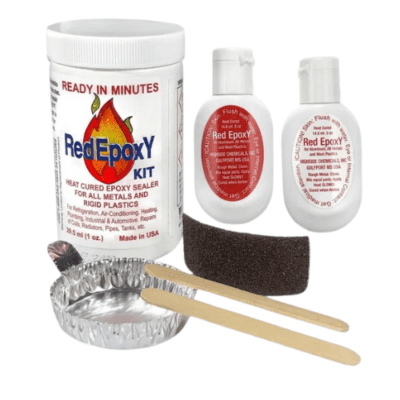
What is Red Epoxy? Red Epoxy is a new high performance,
two-part, heat cured, epoxy repair kit for making permanent repairs on
all metals and rigid plastics. Red Epoxy is specifically designed to exhibit
a distinct color change when heat cured. Red Epoxy will provide a permanent
and effective repair on any rigid material which includes but is not limited
to, aluminum and aluminum alloys, cast irons, copper and copper alloys
(brass, bronze, etc.), magnesium and magnesium alloys, carbon steels,
stainless steels, galvanized surfaces, PVC, CPVC, ABS, fiberglass, black
polypropylene, and Kynar.
How Does Red Epoxy Work?
Initially, the red part (epoxy resin) is mixed with an equal part of the
yellow part (hardener) forming a homogeneous mass. At this point, the
reactants are brought together and allowed to develop sufficient compatibility
before being used. In epoxy chemistry, the time required for the parts
to become compatible is referred to as the induction time. Typically,
an induction time of about 10 minutes is sufficient for Red Epoxy. Once
the parts (or reactants) are brought together the reaction will slowly
begin even without heat being applied. Eventually the reaction will result
in a fully cured epoxy. Red Epoxy will fully cure without heat in 24 to
72 hours depending on temperature and humidity. NOTE: when Red Epoxy is
allowed to cure without heat it retains its deep red color. The period
of time required for an epoxy mixture to become unworkable is referred
to as the pot life. Red Epoxy has a pot life of about 4 hours. This means
that Red Epoxy can be used for repairs up to 4 hours after mixing. Finally,
the Red Epoxy mixture is heated and the reaction rate is accelerated.
When the color changes from red to gold the product is completely cured.
TYPICAL PROPERTIES:
Kit contains (1) .5 ounce red tube and (1) .5
ounce white tube.
Red Tube: Resin
Color Red
Consistency Very viscous paste
White Tube: Hardener
Color Yellow
Consistency Very viscous paste
Maximum Temperature Limit 350šF
Contains no Volatile Organic Compounds (VOC's)
Typical Tensile Shear Strengths of Metal,
*Aluminum alloy 4590 psi
*Steel (pretreated) 5040 psi
*Brass (pretreated) 2135 psi
*Brass (untreated) 1940 psi
*Copper (pretreated) 2950 psi
HYDRAULICALLY PRESSURE TESTED IN EXCESS OF 3000
psi ON 304 and 316 STAINLESS STEEL AND BLACK IRON PIPE.
Making Repairs with Red Epoxy is easy. Just follow
these steps:
1. Squeeze out a small amount of resin from the
red tube and the white tube on any clean surface.
2. Mix the two parts together with a clean spatula or stick into a uniform
red color. This guarantees uniform mixture.
3. For best adhesion, clean the repair area with sandpaper or emery cloth
removing all loose scale, dirt or other foreign matter.
4. Then clean the sanded area with a solvent degreaser such as orderless
mineral spirits to remove any residual oil or grease. Allow the solvent
to evaporate to a dry surface. Do not apply Red Epoxy to a solvent-wet
surface.
5. Place a small amount of the prepared Red Epoxy to the break or area
to be repaired. Be sure to use enough Red Epoxy to cover the area to be
repaired.
6. With a hot-air gun or propane torch, slowly heat the Red Epoxy and
surrounding area. Use a slow brush strokes of hot air or heat from propane
torch and pass directly over the repair area. NOTE: do not use a direct
flame to heat the Red Epoxy to avoid overheating or charring. This heats
the Red Epoxy and base material slowly and uniformly and does not develop
hot spots in the patch. Overheating may result in charring or excessive
running of the repair. If this occurs, remove material and start over.
7. As the heating progresses, the red color will deepen and then fade
to a gold color. When the entire patch is gold, remove the heat source
and allow the work to cool to room temperature. CAUTION: do not force
cool. Rapid contraction of the base material will weaken the resin bond
and a complete cure may not occur.
When the repair has cooled the equipment may be returned to service immediately.
Applications
Anywhere a small hole or crack exist Red Epoxy makes the best repair material.
Red Epoxy does not run and it works on vertical surfaces. Red Epoxy makes
an excellent threaded joint sealant, particularly for hard to seal chemicals
and dissimilar materials. Red Epoxy has a very broad application range
and is used in HVAC, refrigeration, plumbing, automotive, marine, process
piping, petrochemical and manufacturing applications in industrial, commercial
and institutional sectors.
Red Epoxy has successfully repaired aluminum
evaporators, heating coils, hot water heater tanks, pipes, valves, fittings,
metal components, automotive engines, radiators (both plastic and metal),
condensate drip pans, exhaust systems, metal cooling towers, tanks and
boiler tubes. Contact Highside Chemicals for specific applications.
CHEMICAL RESISTANCE: The following is a partial
list of the materials and fluids that Red Epoxy is resistant and includes
but is not limited to
REFRIGERANTS:
R-717 (ammonia)
R-744 (carbon Dioxide)
R-11 (trichlorofluoromethane)
R-12 (dichlorodifluoromethane)
R-21(dichlorofluoromethane)
R-22(chlorodifluoromethane)
R-113 (1,1,2-trichlorotrifluoroethane)
R-114 (1,2-dichlorotetrafluroethane)
R-40 (methyl chloride)
R-30 (methylene chloride)
R-290 (propane)
R-764 (sulfur dioxide)
R-134a (1,1,2-tetrafluoroethane)
R-13, R-13b1, R-500, R-502, R-503, R-123, R-124,R-401A, R-401B, R-402A,
R-402B, R-403B, R-406A, R-408A, R-409A, R-23, R-236fa, R-404A, R-407A,
R407B, R-407C, R-410A, R-507, R-508.
REFRIGERATION LUBRICANTS:
Mineral Oils, Napthenic
Mineral Oils, Paraffinic
Polyol Esters
Polyalkylene Glycols
Polyalphaolefins
Alkylbenzenes
FUEL GASES:
Natural Gas
LPG "Liquefiedl Petroleum Gas"
LNG "Liquefied Natural GAs"
Propane
n-Butane
Isobutane
SOLVENTS:
Water (soft; hard; potable), seawater, Pentane, Hexane, Cyclohexane, Heptane,
Petroleum Napthas, Mineral Spirits, Toluene, Xylene, Perchloroethylene,
D-Limonene, Turpentine, Pine Oil, Lacquer Diluent, Rubber Solvent, VM&P
Naptha, Stoddard Solvent, Deodorized Kerosene, 140šF Solvent, Medium-flash
Aromatic Naptha, High-flash Aromatic Naptha, Dipentene, Chloroform, Orthodichlorobenzene,
Acids-Dilute, Monochlorobenzene, Ethylene Dichloride, Trichlroethylene,
Propylene Dichloride, Aliphatic Solvents, Caustics-Dilute, Aromatic Solvents,
Glycerine, Chlorinated Solvents Alcohols
INDUSTRIAL GASES:
Acetylene, Air, Carbon Monoxide, Ammonia, Argon, Carbon Dioxide, Ethane,
Ethylene Chloride, Fluorine, Hydrogen, Methane, Neon, Nitrogen, Nitrous
Oxide, Propylene, Silane, Xenon, Tetrafluoromethane, Helium.
FUELS:
Gasoline (petrol, motor fuel), Aviation Gas (avgas, jet fuel), Fuel Oils,
Diesel Fuel Oils, Gas Turbine Oils, Kerosene, Gas Oil.
OILS:
Mineral Oils, Soybean Oil, Coconut Oil, Tall Oil, Peanut Oil, Rapeseed
Oil, Menhaden Oil, Vegetable Oil, Animal Oil
Questions concerning specific applications or
chemical resistance should be directed to Highside Chemicals, Inc. Material
Safety Data Sheet and detailed information is available on our Web Site,
http://www.highsidechem.com
|